

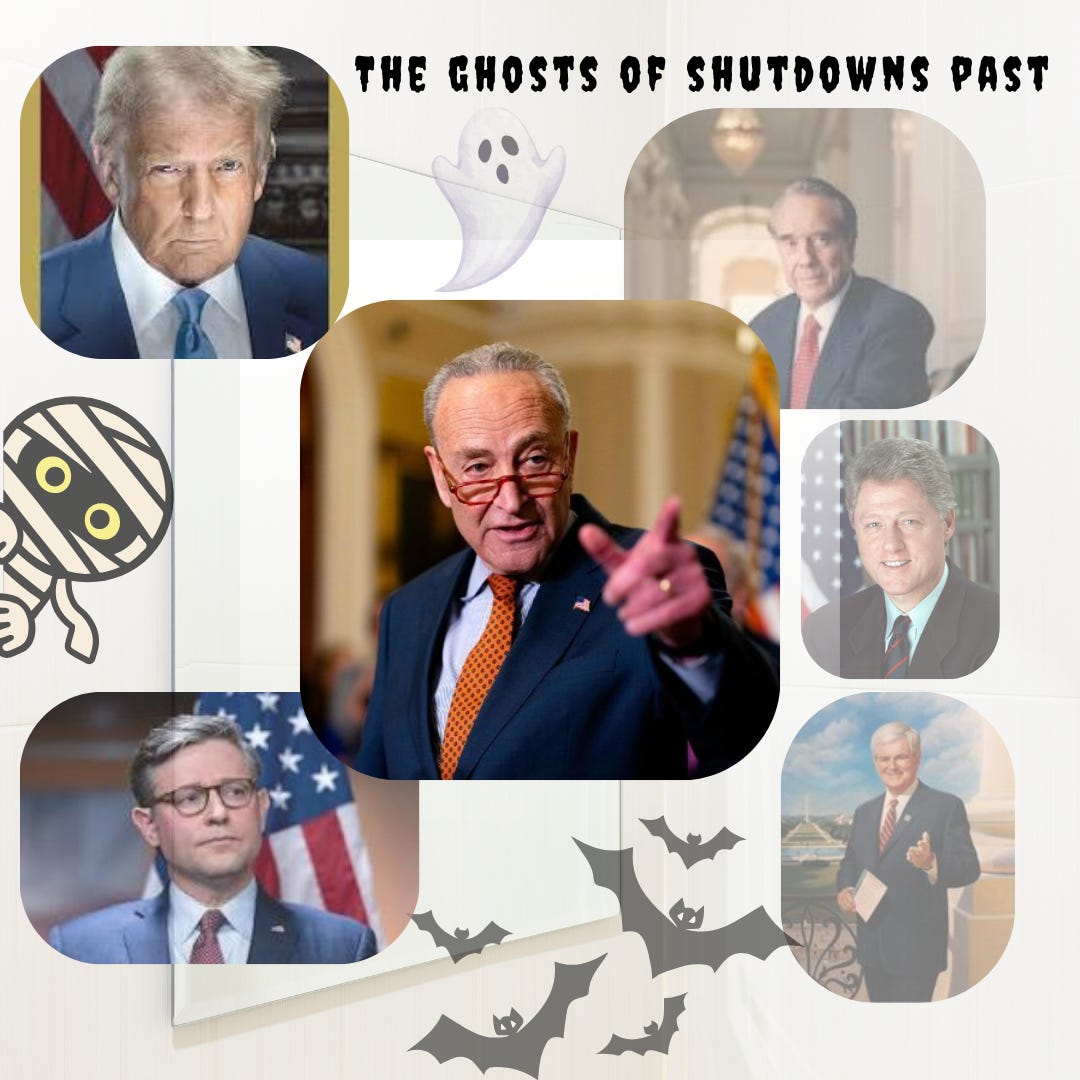
It was 1995 during the Holiday Season in Washington, D.C. The halls of Congress were quiet, but tensions were high behind closed doors. I was working on Capitol Hill and remember it well.
It was the government shut down of 1995 – 1996 – the first since Republicans took back the U.S. House of Representatives after a 40-year drought.
Dissension in Republican Ranks
Georgia Rep. Newt Gingrich was the new Speaker of the U.S. House. He came to office with bold plans, after a stunning victory with his visionary Contract with America. I worked with his team in 1994 in what became a huge victory, with Republicans picking up 54 congressional seats to become the majority party.
Kansas Senator Bob Dole, who I had worked with a couple years before, served as the U.S. Senate Majority Leader.
At this time, the budget standoff was with President Bill Clinton. An interesting point that’s different from today is that although Republicans controlled both the U.S. Senate and the U.S. House, Dole and Gingrich disagreed on strategy.
Speaker Gingrich sought a balanced budget and drastic spending cuts. Dole – ever the pragmatist – felt that a hardline stance wasn’t going to benefit Republicans.
It was no secret that Dole had his eye on the Presidency in 1996. With the budget standoff taking up a three-week period between December 1995 and January 1996, Senator Dole was antsy for a deal, publicly expressing that it was time for Republicans to end the standoff.
Clinton’s Calculated Calm
President Bill Clinton, a shrewd negotiator representing the common man, read the tea leaves the same way Dole did. He knew that a lengthy shutdown would look bad for Republicans. He was correct. The fallout landed squarely on Republicans, with Clinton acting as peacemaker.
Dole would eventually become the 1996 Republican Nominee for President. Several months later, he would lose to President Bill Clinton.
Though Clinton and Dole battled for the Presidency, they became friends. In 2015, Dole awarded Bill Clinton the “Dole Leadership Prize”, at a ceremony I attended at the Dole Institute of Politics.
This was just a month after I served as a Fall Fellow, hosting a program on remarkable women in business & politics.
Interesting History—but What’s the Point?
The point is—there’s a parallel between what happened 30 years ago and today’s budget shutdown. I was in Washington, D.C. last week and had the chance to visit with Republican legislators – all of whom cited the “Schumer Shutdown”.
Partisan Gamesmanship
Last week, Republicans sought to pass a clean Continuing Resolution (CR) to keep the government open and begin negotiations on the 12 appropriations bills that impact every level of government. The Republican House approved the measure, which included extra funding for security in the wake of the Charlie Kirk assassination.
Democrats, led by Senator Chuck Schumer (D-NY) in the U.S. Senate, were ready to play hardball, offering an alternative CR that extended federal government funding through October 31, 2025. The Democrat version included:
-
A permanent extension of Obamacare premium tax credits, set to expire on December 31, 2025.
-
Reversals of Trump cuts to Medicaid and public broadcasting
-
$200 million allocated to cover benefits for undocumented immigrants
-
New limits on presidential power to reduce spending
Republicans said the alternative bill was full of partisan spending demands, totaling $1.5 trillion, with $200 million in taxpayer dollars covering people who came to this country illegally.
Because Republicans hold the Majority in the U.S. Senate, the Democrat measure was voted on and has failed three times. Though the margin in the U.S. Senate is close with 53 Republicans, 45 Democrats, and 2 Independents, the U.S. Senate requires a 60-vote majority, (called cloture) to end debate and force a vote. So, we remain at an impasse.
The Shumer Shuffle
It’s pretty well known that Senator Schumer is doing all he can to appease his Democrat base. Here’s Why:
-
According to Politico, several candidates running as Democrats in Maine in the U.S. Senate primary indicate that they are willing to abandon Schumer as their Senate Leader, if elected to office. This is a slippery slope, since Schumer holds the keys to millions in funding in this targeted state where Senator Susan Collins (R-ME) is considered vulnerable.
-
Of course, there’s a lot of daylight between now and 2028, when Schumer would face election. He may even decide not to run again, given the current scenario.
Trump’s Hand
Like it or not, there seems to be no doubt that President Donald Trump is holding the stronger hand. And unlike 1995 – 1996 government shutdown, Republicans are aligned. According to insiders in Washington, D.C., it is clear that Trump’s team has thought through possible scenarios and has a plan to maneuver in coming days, if the shutdown continues.
Will Leaders Heed the Ghosts of Shutdowns Past?
History doesn’t repeat itself, but it sometimes gives us a glimpse of the future. As we witness the 2025 budget standoff, echoes of 1995 remind us that strategy and planning—not just ideology—shape public perception and political outcomes. The players change, but the stakes—for governance, credibility, and trust—remain the same.
Whether today’s leaders choose pragmatism or posturing may once again determine not just who wins the narrative—but who gets to govern.
Let’s hope they look to the lessons of the past, come to their senses, and return to governing. It’s what they were elected to do.